 White to play

"If you love chess then you are at the right place!"- Sagar Shah.
Wednesday, June 8, 2011

Sunday, May 29, 2011
An instuctive pawn endgame!
I just woke up in the morning pretty dull! and i knew the perfect recipe for making my mood better! i went to playchess and decided to play a 5 min game. the following position arose in the game in which i was white.
 Black to move.
White is clearly better here. maybe even close to winning. the only plausible idea i can think for black is to go Qd4 and exchange the queens! and that is what my opponent played.
1...Qd4 2.Qd4 cd4 3.b3 Rbe8 4.Rae1 Re4!?
1...Qd4 2.Qd4 cd4 3.b3 Rbe8 4.Rae1 Re4!?
 Is a pawn ending good for white?
now black seems to have consolidated his position. all i can tell u is that with just 1 min on the clock left, there are high chances for you to go wrong in such positions. Here i saw tha chance of going into a pawn endgame! and guess what you dont have enough time to claculate the consequences but general knowledge of endgame will help you!
5.Re4! fe4 6.Rf8 Kf8
. White to play.
 White to play.
Well what justifies my decision? well it is absolutely clear that the two kingside pawns will keep
the black king tied up on the kingside. But at the same time the central e4 and d4 pawns tie up my king. but the most important point is that with my a and b pawn against his lone a pawn, i will also be able to make a passer on the queenside! in that way the black king cant protect both his fronts and he loses!! now lets convert these words into moves!
7.Kf2 c5 8.Ke2 a5 9.g4 Kg7 10.h4 Kg6 11.Kd2 Kh6  White to play.
 White to play.
now comes the most important move in this plan
12.c3!! and the game is over. 12...d3 13.a3!
and here my opponent resigned when he realised that a small little pawn is going to march ahead from the queenside making the black king look really dumb on the other side of the board!
the last few moves could have been
13...Kg6 14.b4 cb4 15.cb4(remember to take with the pawn with which he took! ab4 would leave white lost after a4!) ab4 16.ab4 and the b pawn wins the game!

An instructive endgame which made me feel fresh for the entire sunday ahead!
Sunday, February 20, 2011
Position for the day. 19th feb

White to play.
Solution.
Players: Sagar Shah v/s IM Saptarshi Roy.
Position from 2011 Parsvnath tournament.
During a game its very important to be aware of your tactical possibilities. Where you have a superior position it is all the more important to be fully concentrated because the chances of a tactical shot are very high.
In the above position which i reached against IM Saptarshi Roy, it should be clear even to a beginner that white is clearly better. But there is an instant tactical win.
1.Qh7!! threatening the very simple Rd7 and surprisingly black is falling short of moves. 1...Rge8 (of course Nb6 is a terrible move because after 2.Rd8 Rd8 3.Rd8 Kd8 4.Bf6 Kc8 5.Qg8 Kc7 6.Qd8# is a pretty mate!)
2.Qg6! keeping an eye on the e8 rook and again threatening Rd7. 2...Nb6 (the most beautiful idea occurs after 2...Rg8 (2..e5 loses to 3.Rd6) 3.Qf7! and the B and the Q combine to take away all the squares from the rook and black loses an exchange.)
3.Rd8 Rd8 4.Rd8 Kd8 and i guess there is no need to see any further. this position is completely winning due to the h pawn but it is nice to see a move ahead and come to the conclusion that white not only has a positional advantage but also material advantage. 5.Bf6 Kc7 6.Qg3 and black has nothing better than to sacrifice a pawn with 6...e5 and after 7.Qe5+- white has a crushing advantage.
Whenever you have a winning position always be on the look out for tactical possibilities because some great player had once said, "Tactics stem from Superior positions!"
It is very embarassing but i have to say that i lost the above position in my game after i continued with 1.h4 but please do not try losing this position at home. It can be highly dangerous!
Friday, February 18, 2011
Position of the Day.18th Feb.

Black to play.
SOLUTION.
Position taken from: Practical Chess Defense by Jacob Aagaard.
Opponents: Kobese-Areschenko.
Alexander Areschenko is a tremendously talented player from Ukraine. He has won a lot of International tournaments in India, the most recent being Parsvnath 2011.
Here he is a rook down and his king's clothes are shredded to pieces. It remains to see if areschenko is able to find that one beautiful idea which i have to admit is really amazing!
1...Qd5+ 2 b3 (white has to make this move if he wants to make progress) 2...Qc5!!! This move is simply mind blowing. Black is a rook down, his king is in the open and here he is just making a move which improves the position of his queen and throws the ball in white's court!
This move looks very hard to understand but when you look logically, you see that
1. the white queen is tied to its rook.So the queen cant do much.
2.The white rook on its own cant do much damage.
3. The queen on c5 covers all of rook checking squares.
4. from c5 now black queen is threatening to take c2 and give perpetual.
Its white's move now but he cant do anything.
3.Ka1 (3.Kb2 Qd4! {and not3...Qc3 as then after 4.Kb1 Qe1 5.Ka2 black is lost.} 3....Qg1 4.Kb2 Qd4 5.Ka2 Qc5
And its draw!
And miraculously its a draw! What a wonderful defensive idea by Areschenko!
Moral: No matter how bad your position is and how strong your opponent is, never lose hope!
Tuesday, February 15, 2011
Rook ending 1 (Lucena)
LUCENA POSITION

1.Rd1+ cutting off the king by one more file. Ke7 2.Rd4! the famous lucena manoeuvre or the bridge building move.The idea of it will soon be clear. [2.Kc7 Rc2+ 3.Kb6 Rb2+ 4.Ka7 Ra2+ 5.Kb8 and white will have to start all over again.] 2...Ra1 3.Kc7 Rc1+ 4.Kb6 Rb1+ 5.Kc6 Ke6 [5...Rc1+ 6.Kb5 Rb1+ 7.Rb4 is the main idea of the bridge building manoeuvre.]

6.Rd6+! (Rc4 and Re4 both win) Ke7 [6...Ke5 7.Rd5+ Ke6 8.Rb5+-] 7.Rd5+-
Stage-1: Get your passer to the 7th rank and your king to the 8th rank, thus sheltered from annoying checks by the passer itself.
Stage-2: Either earlier or now, make sure that the enemy king is cut off from your passer by 2 files, by driving it away with your rook.
Stage-3: Play your rook to the 4th rank, the key move pointed out by Lucena.
Stage-4: Bring out your king avoiding checks with zigzag movements,taking care to support your passer, till the enemy stops checking.
Stage-5: Get your rook to the 5th rank, taking care if necessary to interpolate the intermezzo check.
This was quite basic but a firm understanding of this position is very important for a player to master the rook endings because finally more than half of the rook endings boil down to this position. So have a firm Grasp of how to win the lucena position.
All the best Ketan!
My friend Ketan Patil is in midst of a very important tournament! These positions are for him so that he can enjoy solving them, learn from them, and win a prize and come back and give us a party!

Black to play.


Black to play.
Solution:
This position has been taken from Jacob Aagaard's book Practical Chess Defense and i will have to agree that it is one of the most brilliant defensive idea i have ever seen. the position isnt very difficult as such but if one can play such an idea during a game then he will surely be immortalised!
This position has been taken from Jacob Aagaard's book Practical Chess Defense and i will have to agree that it is one of the most brilliant defensive idea i have ever seen. the position isnt very difficult as such but if one can play such an idea during a game then he will surely be immortalised!
1...Bd3!! A Brilliant move which i will coin as Decoyflection(which is a synthesis of decoy and deflection). actually this is a nice position to understand the difference between decoy and deflection. If the queen takes the B then it is deflection. We defelected the queen away from the attack. but if the King takes the B then its a decoy because we brought the king to a square which it doesnt want to be on.
A move like 1...Qe7 is refuted by 2.Qh6 Qh7 3.Qf8 Qg8 4.Qh6 Qh7 5.Bf6 Kg8 6.Rg1+-
1...fe5 is also useless as after 2.Qh6 Kg8 3. Rg1 Kf7 5 Rg7 black is slaughtered.
1...fe5 is also useless as after 2.Qh6 Kg8 3. Rg1 Kf7 5 Rg7 black is slaughtered.
To find a move like Bd3 you need a free mind. Once you see that such a move can be played then you will immediately get the answer but thinking of this move in the first place is a challenge. If you can somehow wriggle yourself out of forcing thinking and expand your horizons of selecting a move then you can surely improve as a player.
2.Kd3 Qe7 and now the difference is there for all of us to see Qh6 check will be met with Qh7 counter check!!
Black is up a rook and with some care he went onto win the game!
Position No.2
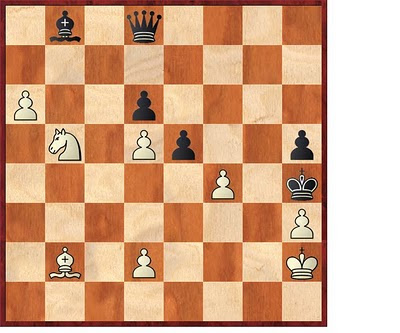
White to play.
White to play.
Solution
This is one of my favourite studies composed by Wotava. It is from the book Studies for Practical players by Mark Dvoretsky. This problem also isnt very difficult but aesthetically very beautiful. If you havent solved it and are trying to see the answer, I would recommend you to give it another shot. Solving this problem will give you great pleasure.
I am sure that you have considered only 2 candidate moves here Nd4 and Bd4 or maybe any one of these.
The funny thing is that 1 Nd4 seems completely winning but has a small problem in it.1...ed4 2.Bd4 and it seems like a forced mate but black has a very cheeky stalemate trick up his sleeve with 2...Ba7! and after 3.Ba7 Qb6!! which actually deserves a diagram.

4.Bb6 and unfortunately its a stalemate!
The right idea is to start with 1 Bd4!! ef4 (1...ed4 loses instantly to Nd4 and Nf3# cannot be averted.) 2.Bf2 Kg5 3. Bh4!! I guess this would have been the most difficult move to find! and now after 3...Kh4 4.Nd4 !

The game is over as Either black gets mated due to Nf3 or loses his queen tp Ne6+.
A very beautiful study you must agree where as in life you have a choice and as always only one of them is correct!!
Friday, February 11, 2011
How to get out of trouble?

BLACK TO PLAY
SOLUTION
As i solved this position from the book practical chess defense (which i must say is an excellent book written by Jacob Aagaard) the above position caught my eye for its simplicity.
first of all i thought a lot as to how i could defend against the threat of taking on f6 and then swinging hois rook over to the kingisde and i came up with 1...Kh8 but then 2Nf6! Bf6 3Bf6 gf6 4.Qh5 and now Rh3 is a threat so 4...Rg8 5.Qf7 and i would never like to be in black's shoes here.
1...Nd5 is highly interesting as move like Bh6 is met with Nc7 and white cannot follow up his attack. but after cd5 2Bg5 de6 white is slightly better.
To find the answer i am sure that there is some very basic knowledge which i learnt when i was young which has to be applied here. that is, always calculate the checks and captures first. of course there are no checks. but captures, yes there are and the first one that comes to mind is 1....Ng4!! which allows a fork but is surprisingly the answer to this problem! 2.Be7 Qc7! yes you guessed it right! A double attack on h2 and e7. 3.Qg4 Qe7 and it is certain that black has superb chances to win this position.
Why would be this position be tough to solve?
I dont know whether you all got the answer easily or it took some while, but i didnt get the answer maybe because i wasnt thinking that the solution can be so easy especially because the position is amidst other ones which are tough! Unforcing thinking is the key!
What does unforcing thinking mean?
Quite simply put unforcing thinking means to think unconventionally. In this position unforcing thinking was to allow the fork by the Bishop. Often we see the fork and reject the variation but unforcing thinking implies to look further into variations which at first sight seem absurd!
Subscribe to:
Posts (Atom)